
What Is a Mobile Swim Academy Service for Kids
- superheroswim
- May 21
- 9 min read

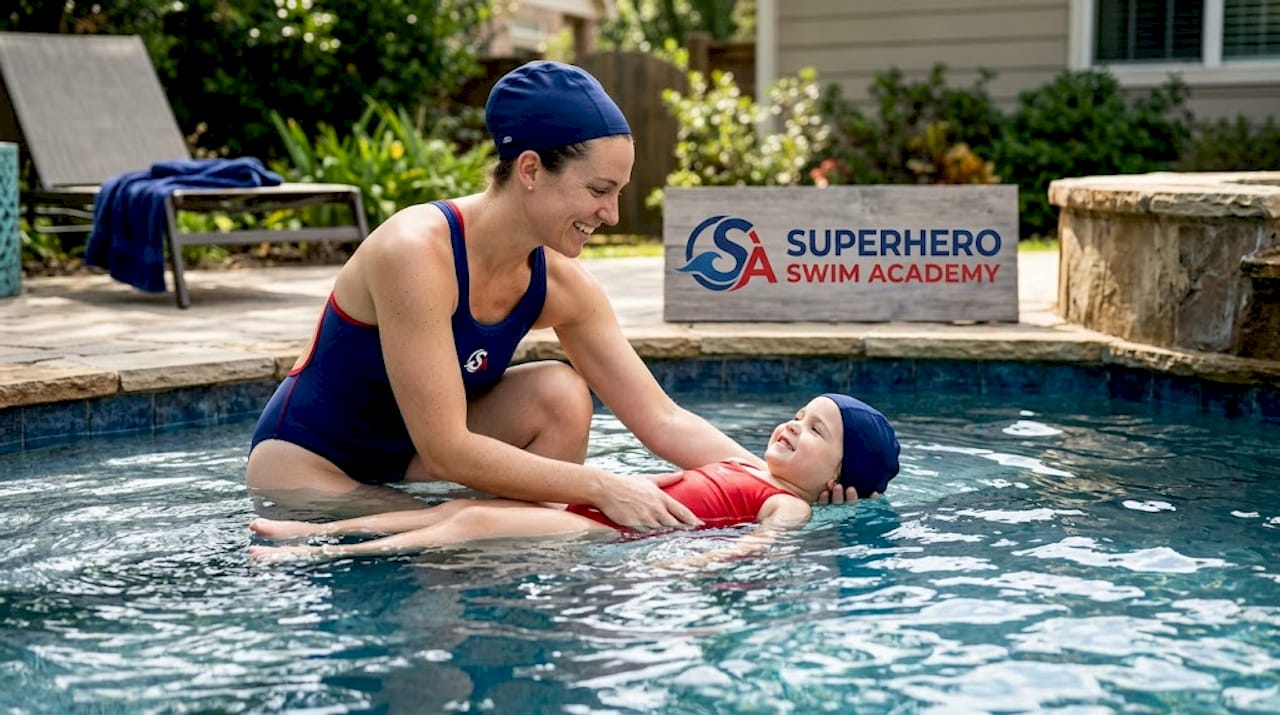
Most parents assume that signing a child up for swim lessons automatically covers water safety. It doesn’t. Knowing how to kick across a pool and knowing how to survive an accidental fall into one are two very different things. A mobile swim academy service closes that gap by bringing private, safety-focused swim instruction directly to your location, whether that’s your backyard pool or a nearby community pool. This guide breaks down exactly how these services work, what to look for, and why they’re worth serious consideration for parents of young children.
Table of Contents
Key takeaways
Point | Details |
Mobile lessons come to you | Instructors travel to your home pool or preferred location, removing commute and scheduling stress. |
Safety skills are the priority | Quality programs teach survival skills like floating and self-rescue, not just stroke mechanics. |
Private format accelerates learning | One-on-one attention helps young children automate safety behaviors faster than group classes allow. |
Instructor credentials matter | Look for CPR, First Aid, and nationally recognized swim curriculum certifications before enrolling. |
Cost reflects real value | Private mobile lessons typically run $50 to $200 per session, with faster skill gains than group lessons. |
What a mobile swim academy service actually is
A mobile swim academy service is exactly what the name suggests. Instead of driving your child to a facility, a certified swim instructor comes to you. Lessons take place at your home pool, a neighbor’s pool, or any agreed-upon aquatic location. The instructor brings all necessary teaching equipment, manages the lesson setup, and delivers a structured curriculum tailored to your child’s age and ability level.
This is not the same as hiring a random neighbor who swims well. Reputable mobile swim academies operate with formal curricula, certified instructors, and documented safety protocols. The private lesson format means your child gets undivided attention from the first minute to the last, which is a significant departure from the six-to-one ratios common in group classes at community centers.
Here’s how mobile swimming works in practice:
You schedule a lesson through the academy’s booking system, often online or by phone
The instructor arrives at the agreed location with floatation aids, teaching props, and a lesson plan
The session runs 20 to 45 minutes depending on the child’s age and stamina
Parents receive a progress update after each lesson, including skills practiced and goals for next time
Lessons repeat on a consistent schedule to build muscle memory and reinforce safety behaviors
Pro Tip: Ask any mobile swim provider whether their lesson plans are written or standardized. A verbal “we customize everything” is not the same as a documented curriculum with measurable milestones.
The scheduling flexibility alone makes on-demand swim coaching attractive for families with unpredictable routines. But the real draw is the quality of instruction that becomes possible when a child isn’t competing for an instructor’s attention with five other kids.
Why mobile lessons work especially well for young children
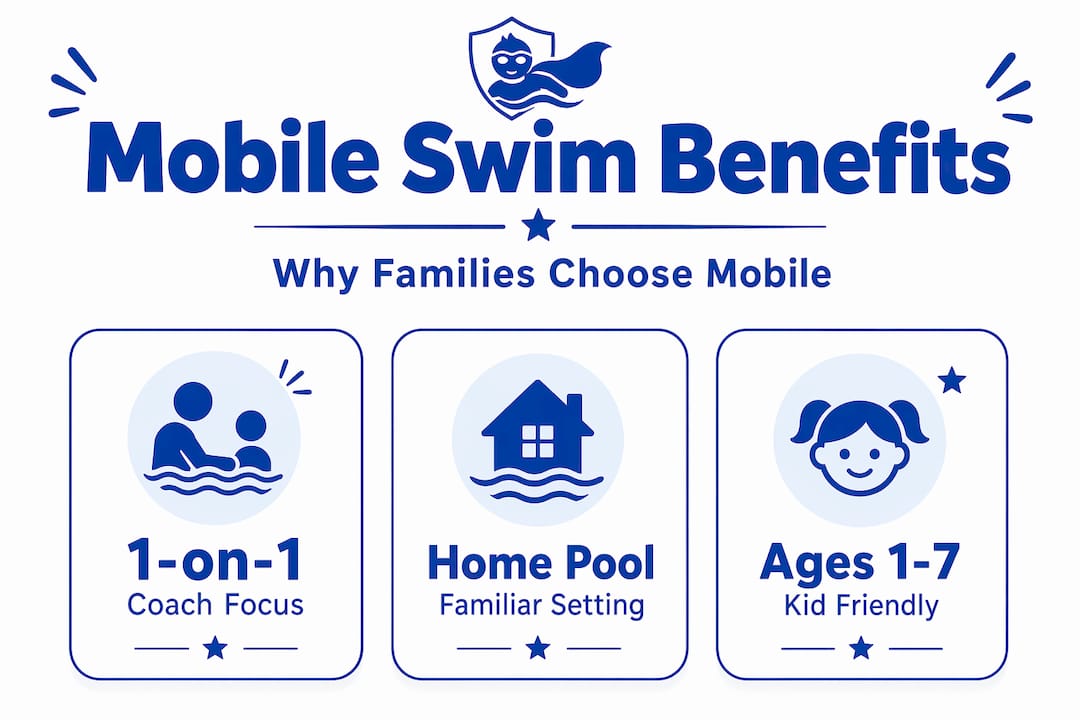
Young children learn differently than older kids. Their attention spans are short, their anxiety around new environments is real, and their ability to absorb safety-critical information depends heavily on feeling calm and comfortable. A mobile swim academy service addresses all three of those factors at once.
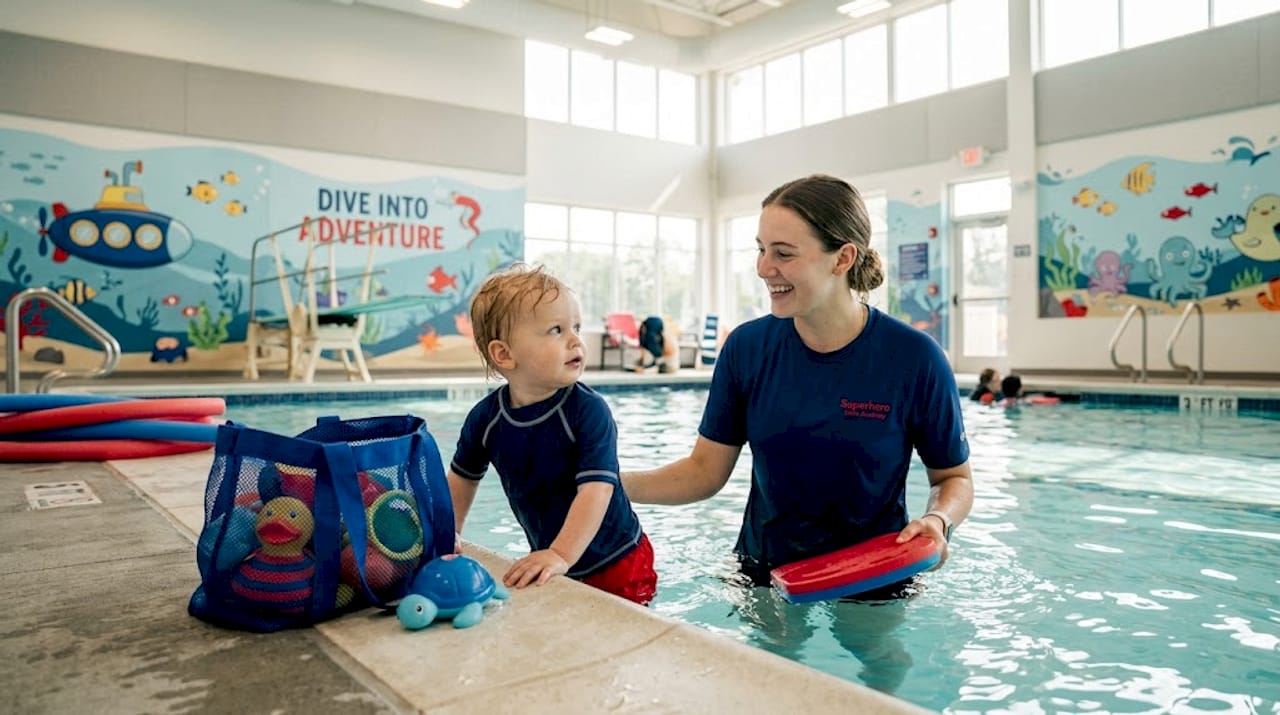
The American Academy of Pediatrics recommends swim lessons as an important layer of protection for children aged 1 to 4, specifically noting that lessons must be combined with close supervision to reduce drowning risk. That recommendation carries more weight when you realize how many group swim programs focus almost entirely on stroke development and spend very little time on survival skills like floating face-up, recovering from an unexpected submersion, or safely exiting a pool.
Mobile lessons change that equation. Because the instructor works with one child at a time, they can repeat survival drills as many times as needed without worrying about holding up a class. Repeated drills in a familiar environment build the muscle memory that makes survival responses automatic rather than something a child has to think about under stress.
The benefits of mobile swim lessons for toddlers and young children include:
Comfort in a familiar setting. A child who has splashed in your backyard pool before is far less anxious than one entering a chlorine-heavy facility for the first time. Lower anxiety means faster learning.
Focused survival skill training. Water survival skills training in young children measurably improves outcomes, particularly when programs go beyond stroke mechanics to include self-rescue and water entry behaviors.
No crowd exposure. For toddlers especially, large group settings create sensory overload. Private lessons remove that barrier entirely.
Schedule on your terms. Mobile swim academies typically offer morning, afternoon, and weekend slots. You pick what works for your family’s week, not the other way around.
Faster skill acquisition. One-on-one instruction reduces distractions and allows instructors to identify and correct technique errors in real time, which accelerates progress compared to group settings.
Safety components every quality program should include
Not every mobile swim lesson provider operates at the same standard. When you’re searching for a swim academy near me, the quality of the safety curriculum is the most important filter you can apply.
A quality mobile swim academy program should deliver the following in sequence:
Instructor certification verification. Qualified swim instructors must hold current CPR and First Aid certifications alongside nationally recognized swim teaching credentials. Ask to see documentation before the first lesson.
Survival skills as a core curriculum element. This means teaching children how to float independently, roll from face-down to face-up, and reach the pool wall or steps without adult assistance. Stroke technique comes after these foundations are solid.
Safe entry and exit training. Children need to know how to get out of a pool safely, not just how to swim across it. This includes understanding pool edges, steps, and ladders.
Stress-response conditioning. Mobile lessons’ private format allows instructors to practice simulated surprise scenarios, training children to respond calmly when they enter water unexpectedly.
Parent engagement and supervision guidance. Lessons should reinforce that parental vigilance is a non-negotiable layer of protection. A good instructor will explicitly discuss supervision practices with caregivers, not just with the child.
Pro Tip: During your first consultation call, ask the instructor to describe what they do if a child panics mid-lesson. Their answer will tell you everything about their training depth and temperament.
The combination of certified instruction and parent engagement is what separates a genuinely protective program from one that simply teaches children to splash around confidently.
How to choose a reputable mobile swim academy
Finding personal swim training services for your child requires more than a quick Google search. Here’s a practical framework for evaluating any provider you’re considering.
Check credentials first. Every instructor should hold CPR and First Aid certifications that are current, not expired. Ask which swim teaching curriculum they’re trained in and whether it includes survival skills alongside stroke development.
Evaluate the curriculum’s scope. Programs that teach only freestyle and backstroke are incomplete for young children. The curriculum should explicitly include floating, self-rescue, safe pool entry and exit, and age-appropriate water safety awareness.
Ask about the lesson structure. How long is each session? What is the student-to-instructor ratio? Can lessons be customized if your child has specific fears or physical considerations? A provider who can’t answer these questions clearly is a provider who hasn’t thought them through.
Read parent reviews carefully. Look for testimonials that mention specific skill improvements, not just “my kid loves it.” Reviews that describe a child learning to float independently or recovering from a submersion are far more meaningful than general praise.
Here’s a quick comparison to help you evaluate options:
Evaluation factor | What to look for | Red flag |
Instructor credentials | Current CPR, First Aid, and swim curriculum certification | Verbal assurance with no documentation |
Curriculum depth | Survival skills plus stroke development | Stroke-only focus |
Lesson customization | Tailored to child’s age, ability, and comfort level | One-size-fits-all approach |
Parent communication | Regular progress updates with specific goals | Vague feedback after lessons |
Scheduling flexibility | Multiple time slots, easy rescheduling | Rigid schedule with penalty fees |
For a deeper look at what separates effective providers from average ones, the guidance on choosing effective swim lessons covers the key differentiators worth understanding before you commit.
What mobile swim lessons cost and how to budget
Private mobile swim lessons typically range from $50 to $200 per session, with most quality providers landing in the $75 to $150 range depending on location, instructor experience, and lesson length. That’s higher than a group class at a community center, but the comparison isn’t quite apples to apples.
A group class at $15 per session with six children in the water means your child receives roughly 10 minutes of actual instructor attention in a 60-minute class. A private mobile lesson at $100 delivers 30 to 45 minutes of focused, individualized instruction. The per-minute cost of real instruction is often lower with private lessons than it appears on the surface.
Factors that influence pricing include:
Geographic location and instructor travel distance
Instructor qualifications and years of experience
Lesson duration and frequency
Whether the provider uses a structured, proprietary curriculum
Pro Tip: Ask providers whether they offer package pricing for booking multiple lessons upfront. Most mobile swim academies discount 10 to 20 percent for packages of 8 or more sessions, which also locks in your preferred time slot.
For a detailed breakdown of what drives pricing differences, the swim lesson pricing guide at Superheroswimacademy walks through the specific factors parents should weigh.
My honest take on mobile swim lessons
I’ve worked with hundreds of young children learning to swim, and the single biggest gap I see in traditional group programs is the assumption that stroke practice equals water safety. It doesn’t. A child who can swim 10 meters in a controlled setting may still panic and struggle if they fall into a pool unexpectedly. That gap is what mobile, private instruction is uniquely positioned to close.
What I’ve found in private lesson settings is that children automate safety behaviors much faster when the instructor can repeat a specific drill six or eight times in a single session without worrying about pacing a group. That repetition is what builds genuine reflexive response, not just conscious technique. It’s the difference between a child who knows how to float and a child who floats automatically when they need to.
I also want to be direct about something most swim lesson marketing glosses over: lessons are one layer of protection, not the whole shield. Close supervision around water remains non-negotiable regardless of how skilled a child becomes. The best mobile swim programs I’ve seen are the ones that communicate this honestly to parents and build caregiver education into every lesson, not just child instruction.
If you’re weighing mobile lessons against group classes for a toddler or young child, my experience is clear. The private format, the survival skill focus, and the comfort of a familiar environment combine to produce faster, more durable results. That’s not a sales pitch. It’s what the data and the kids in front of me have consistently shown.
— SUPERHERO
Start your child’s swim journey with Superheroswimacademy
Superheroswimacademy brings certified, survival-focused swim instruction directly to families across Palm Beach and Broward counties. Every instructor completes rigorous CPR, First Aid, and the academy’s own proven survival swim curriculum before teaching a single lesson. With over 2,500 children taught, parents consistently report measurable improvements in water confidence and safety skills within just a few sessions. Lessons are tailored to each child’s age and comfort level, and parents receive clear progress updates after every session. Whether you’re looking for swim lessons near you or want to explore supplementary resources, Superheroswimacademy also offers online water safety courses to support learning between sessions. Check available service locations and reach out to get started.
FAQ
What is a mobile swim academy service?
A mobile swim academy service sends a certified swim instructor to your home pool or preferred aquatic location for private lessons. It combines the flexibility of on-demand scheduling with a structured curriculum focused on both stroke development and water survival skills.
At what age can children start mobile swim lessons?
Many mobile swim academies, including Superheroswimacademy, offer lessons starting from infancy. The American Academy of Pediatrics supports swim lessons for children aged 1 and older as a meaningful layer of drowning prevention when combined with active supervision.
How do mobile swim lessons differ from group classes?
Mobile swim lessons are private or very small-group, meaning the instructor focuses entirely on one child’s needs. This allows for more survival skill repetition, faster error correction, and a pace tailored to the individual child rather than a class average.
Are mobile swim instructors as qualified as facility-based instructors?
They should be, and at reputable academies they are. Look for instructors with current CPR and First Aid certifications and training in a recognized swim curriculum. Superheroswimacademy requires all instructors to complete its proprietary survival swim curriculum before teaching.
How many lessons does a young child typically need?
Progress varies by age, starting ability, and lesson frequency, but parents working with Superheroswimacademy report noticeable improvements within just a few sessions. Consistent weekly lessons over two to three months typically produce solid foundational water safety skills in toddlers and young children.
Recommended
Comments