
Survival Swim Explained: Safety Skills Every Parent Should Know
- superheroswim
- 6 days ago
- 10 min read

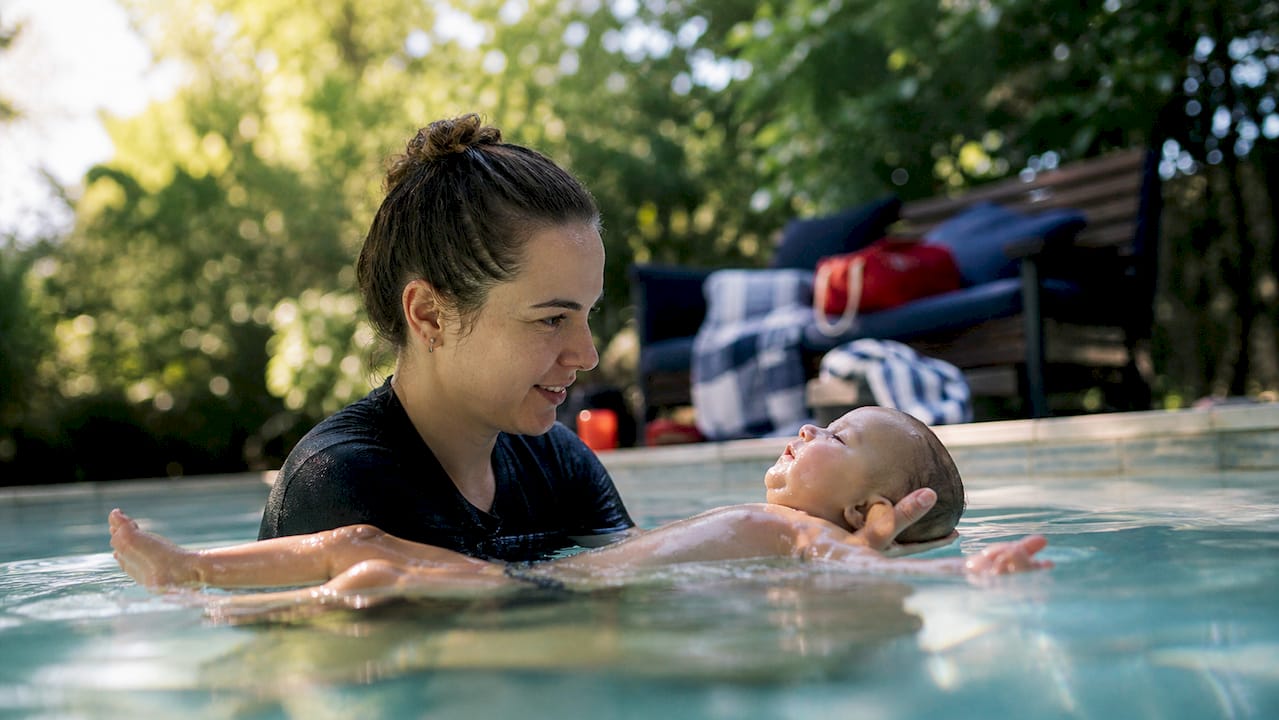
Survival swim is the practice of teaching children — including infants and toddlers — the minimum self-rescue skills needed to survive an unexpected fall into water. It covers orientation after entry, rolling to float, treading water, and swimming to safety, rather than perfecting freestyle technique. The RLSS defines survival swimming as exactly this: the foundational skills to keep a child alive in deep water until help arrives.
Two things parents should do right now, before reading further:
Keep barriers and supervision in place. Survival swim reduces risk; it does not replace a fence, a locked gate, or an adult within arm’s reach.
Ask any instructor about their CPR/First Aid certification and their instructor-to-child ratio before booking. For infants, one-on-one instruction is the standard to demand.
The Lifesaving Society’s Swim to Survive standard frames the goal simply: roll into deep water, tread for one minute, swim 50 meters to safety. That three-step sequence is the benchmark parents can use to measure whether a program has a real finish line or just vague promises. Programs like the Infant Swimming Resource (ISR), Swim to Survive, and Superheroswimacademy each build toward that kind of measurable outcome.
Key Takeaways
Survival swim teaches children the minimum self-rescue skills to survive an unexpected fall into water, and it works best when paired with physical barriers, active supervision, and a program that tracks measurable milestones in writing.
Point | Details |
What survival swim is | Self-rescue skills (roll-to-float, swim-float-swim, treading) taught to survive an unexpected fall into water. |
It is a layer, not a replacement | Survival swim reduces drowning risk but does not replace pool fencing, locked gates, or adult supervision. |
Demand written milestones | Any credible program tracks measurable outcomes (e.g., float unsupported, swim 50 m) and shares progress reports with parents. |
Instructor credentials are non-negotiable | Require current CPR/First Aid certification and one-on-one ratios for infants before enrolling. |
Superheroswimacademy | Offers structured survival swim lessons with CPR-certified instructors and written milestones in Palm Beach and Broward counties. |
Table of Contents
What survival swim programs actually teach your child
The core of any credible survival swim program is a short list of skills that work together in sequence. A child who falls into a pool unexpectedly needs to do several things in rapid order, and each skill below addresses one of those steps.
Orientation and rotation after entry. The child learns to right themselves after an unexpected submersion, find the surface, and locate the pool edge or a safe exit point.
Roll-to-float (rollback float). One of the signature skills in infant and toddler programs: the child rolls from a face-down position onto their back and floats independently, buying time until help arrives.
Swim-float-swim. A progression where the child swims a short distance, rolls to float to rest, then continues swimming. You can read a detailed breakdown of this technique in this swim-float-swim parent guide.
Treading water. Sustaining a vertical position at the surface using arm and leg movements, typically targeted for older toddlers and children.
Basic exit techniques. Reaching a wall, grabbing a ladder, or pulling out of the water independently.
Rescue awareness. Age-appropriate understanding of calling for help, reaching for an object, or staying calm.
Water safety knowledge. Many programs include CPR awareness for older children and basic rules (never swim alone, always tell an adult).
Measurable milestones vary by program and age. The Swim to Survive standard targets swimming a moderate distance and sustaining treading for a short period. ISR-style programs for infants often set milestones around unsupported floating for a defined duration and independent rollback. Ask your program to show you their written assessment criteria before the first lesson.
Pro Tip: If a program cannot name a specific, measurable milestone for your child’s age group, that is a warning sign. Real evidence-based programs track progress in writing and share it with parents regularly.
How survival swim differs from traditional swim lessons
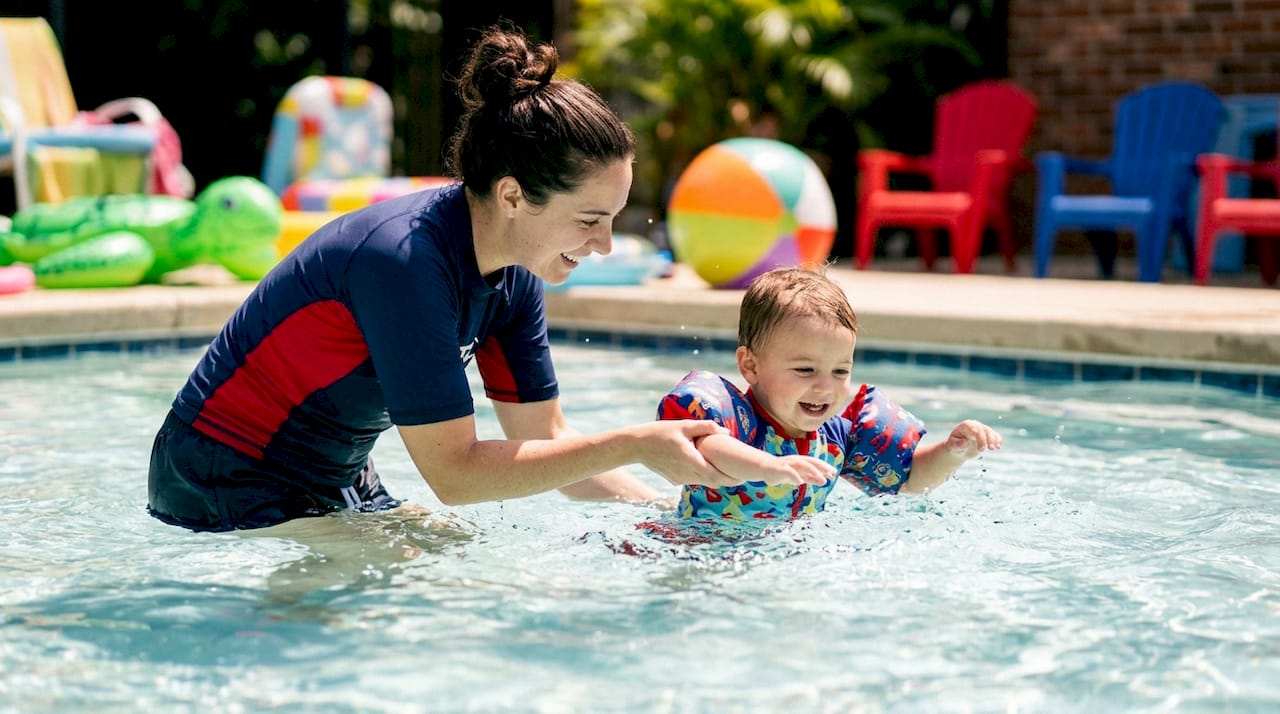
The simplest way to put it: traditional lessons teach children how to swim well; survival swim teaches them how to stay alive if something goes wrong.
Traditional group swim lessons follow a progressive stroke curriculum — freestyle, backstroke, breathing technique, flip turns. They are usually play-based, run in groups of 4–8 children, and measured by stroke quality and distance over months or years. That model is excellent for building confident, capable swimmers over time.
Survival swim programs are built around a different question entirely: what does a child need to do in the first 60 seconds after an unexpected fall? The curriculum reflects that urgency.
Format: Often one-on-one or very small ratios (especially for infants), with high-repetition drills simulating real emergency scenarios — clothed entries, unexpected submersions, disorientation recovery.
Intensity: Less play, more repetition of specific emergency responses. A child may practice the rollback float dozens of times in a single session.
Outcome focus: The goal is a specific, testable survival sequence, not a polished stroke. U.S. Marines water-survival training illustrates this principle well: military survival programs train task-oriented skills for the expected environment, not stroke aesthetics.
Timeline: Basic survival competency can be reached in weeks for some children; traditional stroke proficiency takes years.
Survival swim is a layer, not a replacement. Aquatic safety professionals consistently note that survival skills are a foundational first step, and as children grow, those skills should be complemented with progressive stroke instruction and broader water safety education. The two approaches work best together.
What age can children start, and is it safe?
Some programs advertise starting ages as early as six months. The RLSS notes that program designs vary by nation and age group, and that infant readiness depends on developmental factors and the specific safety measures a program uses. Six months is not a universal standard — it is the lower boundary some structured infant programs work within, under specific conditions.
Is infant survival swim safe? For healthy infants in a well-designed program with a qualified instructor, the evidence supports it as a reasonable safety investment. The key word is “well-designed.” A program that rushes infants through drills without monitoring distress, skips parent communication, or lacks a documented curriculum is a different proposition entirely.
Safety safeguards parents should require before enrolling an infant or toddler:
Instructor CPR and First Aid certification. Non-negotiable. Read more about why this matters in this breakdown of CPR-certified swim instructors.
Documented curriculum with written assessment milestones. Ask to see it.
One-on-one instruction for infants. Group ratios are not appropriate for children under roughly 3 years old in a survival-focused program.
Pool temperature controls. Infants lose body heat quickly; water should be warm enough (typically 88–92°F for infant programs) to prevent hypothermia during repeated submersions.
Parental involvement policy. You should know what happens in every lesson, and you should receive progress reports.
Clear distress protocols. Ask specifically: “How do you handle a child who is consistently distressed?” A good instructor has a documented answer.
Pro Tip: For infant classes specifically, prefer programs that offer a trial lesson or observation period before committing to a full package. A reputable program will welcome your scrutiny.
What to expect: lesson format, timeline, and costs
Most survival swim programs for infants and young children follow one of three formats:
Private one-on-one lessons (ISR-style): 10–20 minutes per session, 4–5 days per week for 4–6 weeks. Intensive frequency accelerates skill acquisition for young children whose attention spans are short.
Small group classes (2–4 children): 30–45 minutes, 2–3 times per week. Better suited to toddlers aged 2.5 and up who can follow group instruction.
Parent-and-child sessions: A caregiver participates in the water alongside the child. Common for children under 18 months and for families who want to reinforce skills at home.
Realistic timeline to basic survival competency:
Infants (approximately 6 months to 18 months): Several weeks of consistent lessons to reach a reliable rollback float.
Toddlers (approximately 18 months to 3 years): Several weeks of training to progress through swim-float-swim over short distances.
Preschoolers (approximately 3 to 5 years): Several weeks to reach a basic survival sequence including treading and swimming to safety.
These are ranges, not guarantees. Prior water exposure, temperament, and physical development all affect pace. Home swim lessons can accelerate progress by removing the travel barrier and keeping the environment consistent.
Before you book, check these items:
Pool water temperature (ask for the exact range used for your child’s age group)
Instructor credentials (CPR, First Aid, program-specific certification)
Written assessment plan with named milestones
Cancellation and make-up lesson policy
Parent communication method (written reports, app, in-person debrief)
Cost ranges vary widely by market and format. Private ISR-style programs in South Florida typically run in the range of several hundred dollars for a full session package; small group classes are generally less per session. Always verify current pricing directly with the provider, as rates change.
How to choose a survival swim program
The decision framework is straightforward: safety first, credentials second, logistics and cost last. Here is how to work through it.
Must-have credentials:
Documented, written curriculum (not just a verbal description)
Instructor CPR and First Aid certification, current
Documented assessment milestones for your child’s age group
Demonstrated experience with infants if your child is under 18 months
Appropriate instructor-to-child ratio (1:1 for infants, no more than 1:3 for toddlers)
Questions to ask when you call or visit:
“What are the specific, measurable milestones for my child’s age?”
“How do you handle a child who is consistently distressed during lessons?”
“Can I observe a lesson before enrolling?”
“How do you communicate progress to parents?”
“What is your policy if my child is sick or misses a session?”
Red flags to walk away from:
No written assessment protocol or vague answers about milestones
Pressure to reduce supervision or barriers at home because “they can swim now”
Claims that a child is “guaranteed” to survive any water emergency
No parent progress reporting
Group classes for infants under 18 months
For a deeper look at how to compare local providers, this guide on selecting swim lesson providers walks through the key evaluation criteria. Personalized coaching consistently produces faster, safer outcomes for young children than generic group formats, which is worth weighing when comparing options.
The research and standards behind survival swim
Survival swim is not a marketing term invented by swim schools. It has a documented evidence base and recognized international standards.
Key standards:
RLSS/ILS guidance: The RLSS defines survival swimming around a core skill set (orientation, flotation, treading, swimming to safety, rescue skills) and references ILS-suggested minimums including swimming at least 25 meters and maintaining flotation for one minute.
Swim to Survive (Lifesaving Society): The Swim to Survive standard defines a three-step minimum: roll into deep water and orient, tread for one minute, swim 50 meters. It is explicitly a minimum first step, not a complete swimming education.
Swim to Survive+: The expanded standard adds skills with clothes on, basic rescue assists, and fitness elements for older children and young adults.
What the research shows:
A randomized controlled trial found that a structured survival swimming education program significantly improved water safety knowledge, attitudes, and survival skills compared with a control group, and those gains held at a three-month follow-up. That kind of retention matters: a skill that disappears after two weeks of no practice is not a safety net.
Standard | Governing Body | Core Sequence | Target Age |
Lifesaving Society (Canada) | Roll → tread 1 min → swim 50 m | School-age children | |
Swim to Survive+ | Lifesaving Society (Canada) | Above + clothes on, rescue assists | Pre-teens/young adults |
RLSS/ILS Minimum | RLSS / ILS | Orient → float → swim 25 m | Varies by program |
ISR Self-Rescue | Infant Swimming Resource | Roll-to-float, swim-float-swim | 6 months–6 years |
What Superheroswimacademy has learned from teaching over 2,500 children
The most common mistake parents make is treating survival swim as a one-and-done milestone. A child who nails the rollback float at 18 months still needs that skill reinforced at 2, at 3, and beyond. Skills erode without practice, and children’s bodies change fast enough that what worked physically at one age needs to be re-learned at the next.
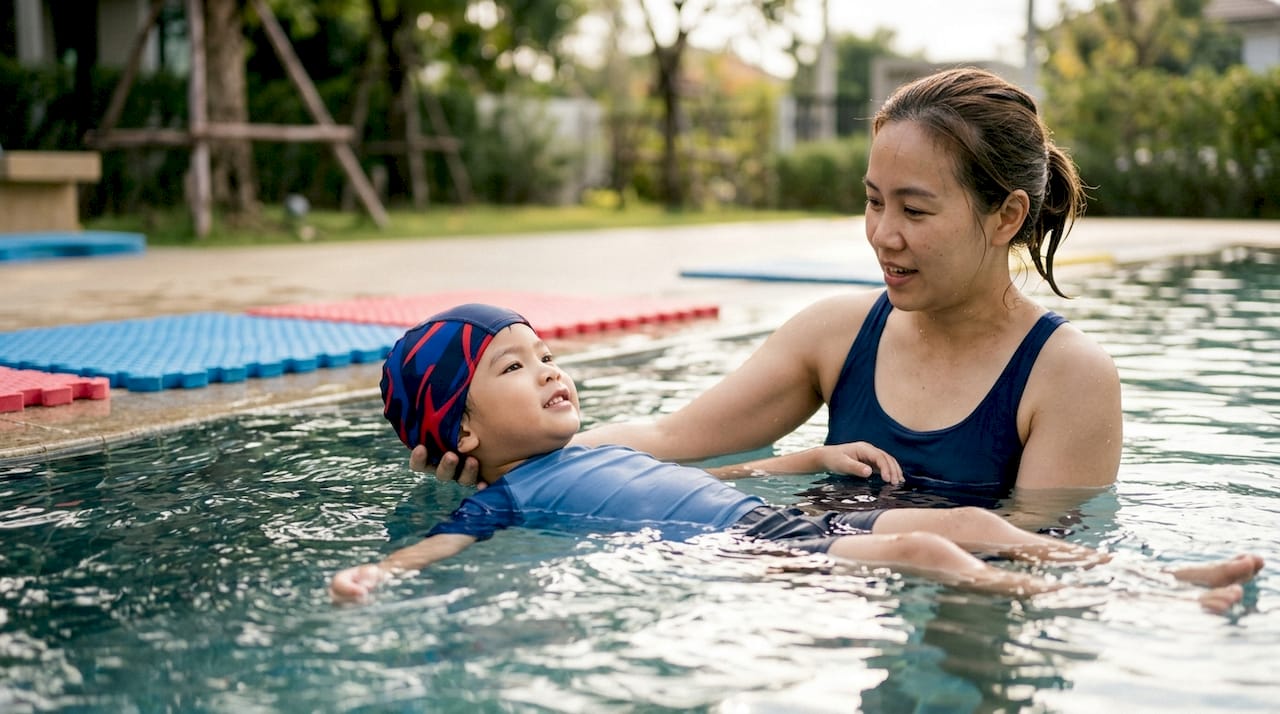
At Superheroswimacademy, instructors measure progress against written milestones and communicate those results to parents after every session. That feedback loop is not a courtesy — it is how parents can tell whether a program is actually working or just keeping a child busy in the water. After teaching more than 2,500 children across Palm Beach and Broward counties, the pattern is consistent: children whose parents stay engaged with the milestone reports progress faster and retain skills longer.
Survival swim genuinely reduces risk. It does not eliminate it. A child who can roll to float is safer than one who cannot, but they still need a fence around the pool, a locked gate, and an adult who is watching. Pairing lessons with physical barriers at home is the combination that actually moves the needle on drowning prevention. Pool electrical safety, including proper pool bonding and RCD protection, is another layer of home safety worth reviewing with a qualified electrician.
Superheroswimacademy: survival swim lessons in Palm Beach and Broward counties
Families in Palm Beach and Broward counties who want survival swim training with documented credentials have a direct option: Superheroswimacademy offers private one-on-one infant and toddler lessons, small group classes, parent-and-child sessions, and luxury concierge instruction at your home pool. Every instructor holds current CPR and First Aid certification and teaches from a structured survival curriculum with written assessment milestones shared with parents after each session.
For parents who prefer to learn alongside their child or who want to reinforce skills between lessons, Superheroswimacademy also offers online courses that walk parents through the same techniques instructors use in the water. Professional swim instructors can access certification training through the same platform.
The starting point is simple: visit Superheroswimacademy to check availability, review lesson formats, and book a session or ask questions directly. Spots fill quickly in both counties, so checking availability now is worth the two minutes it takes.
Sources
This article is general information, not a substitute for advice from a qualified doctor. Consult a qualified healthcare professional about your own circumstances before acting on anything here.
Recommended
Comments